


Mirror quality in an eyeshadow palette refers to how well the integrated mirror performs its three core jobs: delivering a clear, undistorted reflection of the user's face, staying securely and flatly mounted inside the compact or palette lid, and surviving the mechanical and environmental stresses of daily use, transport, and a shelf life that can stretch to two or three years. In practice, mirror quality is determined by four things: the substrate (real glass, acrylic/PMMA, or polycarbonate), the coating system (silvered glass versus vacuum-metallized plastic), the mounting method (adhesive type, glue coverage, and tolerance stack-up), and the interaction between the mirror and the hinge or lid assembly. A mirror that fails any one of these areas produces the defects buyers see most often in the field: wavy or funhouse-style distortion, a green or gray color cast, delamination or black-edge corrosion, scratches out of the box, chipped corners, or a mirror that rattles, tilts, or falls out entirely.
Before committing to mass production, buyers should run a short, practical checklist. First, confirm the mirror substrate and thickness specification in writing, because "glass mirror" can mean anything from a 0.8 mm fragile wafer to a 2.5 mm chemically strengthened glass, and the difference shows up in breakage rates during shipping. Second, inspect reflectivity and color neutrality under white light — a quality glass mirror should reflect 85–95% of incident light with no visible tint when compared against white paper. Third, check flatness with a straightedge, since more than about 0.3–0.5 mm of bow across a 60 mm mirror will create visible face distortion. Fourth, examine the backing: the protective copper layer and two-coat backing paint must cover 100% of the surface with no pinholes, and edges should be sealed to prevent oxidation. Fifth, verify adhesive application — glue must not overflow onto the front surface, the mirror must sit parallel to the lid plane within roughly 1–2 degrees, and there should be no rattle when shaken. Sixth, test the hinge and lid interaction: a lid that snaps shut with excessive force will eventually scratch or crack the mirror, and the hinge itself should survive 3,000–5,000 open-close cycles. Finally, run a humidity chamber test (typically 48 hours at 40°C and 90–95% relative humidity) to catch fogging, blistering, and delamination before your customers do. This article walks through each of these checks in detail, explains why defects happen at the factory level, and gives you field-testable verification methods you can use during inspection — no laboratory required.

The mirror is not a decorative afterthought; it is a functional component that directly shapes how end consumers judge the entire product. When a customer opens a palette to apply or touch up makeup, the mirror is the surface she looks into. If the reflection is warped, dim, tinted, or fogged, the negative impression attaches to the brand — not to the mirror supplier. This is why mirror quality belongs on the buyer's inspection checklist alongside pan fill weight, closure force, and print registration, even though the mirror often accounts for less than 5% of the unit's bill of materials.
Functionally, an eyeshadow palette mirror has four roles. First, it enables application: the user needs a reflection that is geometrically accurate enough to align eyeliner and blend shadow edges, which requires flatness within a few tenths of a millimeter across the reflective area. Second, it supports the perceived value of the packaging. In beauty retail, weight, clarity, and finish are the tactile and visual cues that separate a mid-market palette from a promotional giveaway, and a bright, neutral mirror is one of the strongest of those cues. Third, the mirror contributes to structural perception — a mirror firmly bonded into a rigid lid makes the whole assembly feel solid, while a loose one telegraphs cheapness with every shake of the bag. Fourth, in many designs the mirror acts as a stress-bearing element: in clamshell palettes the mirror often sits in the lid directly behind the hinge zone, where it absorbs lid-drop energy and hinge torsion. Understanding these roles explains why the checks later in this article focus as much on mounting mechanics and substrate choice as on optical performance.
It also matters commercially. Cosmetic Packaging is a category where returns and complaints are driven disproportionately by a handful of visible defects, and mirrors are implicated in several of the most common ones: breakage in transit, corrosion spots appearing after weeks in humid warehouses, and "funhouse" distortion reported in customer reviews. For a private-label buyer, a 1–2% field defect rate on mirrors can erase the margin on an entire production run once you factor in replacement freight, customer service load, and review damage. Checking mirror quality before mass production is one of the cheapest forms of insurance available in this category.
The first specification to pin down is the substrate. Three materials dominate the cosmetic mirror market: real float glass (usually silvered), acrylic (PMMA, usually vacuum-metallized with aluminum), and polycarbonate (PC, also metallized). Each occupies a different point on the trade-off curve between optical quality, weight, impact resistance, and cost, and choosing the wrong one for your market position is a more expensive mistake than any single defect.
Silvered float glass is the benchmark. It offers the highest reflectivity (typically 88–95% for quality cosmetic-grade mirror glass), excellent surface flatness because float glass is produced on a molten tin bath that yields an inherently flat surface, and complete resistance to scratching in normal use — glass hardness is aRound 5–6 on the Mohs scale, far above anything a makeup brush or powder puff can dish out. Its weaknesses are weight (roughly 2.5 g per Square centimeter per millimeter of thickness) and brittleness: a 1.5 mm untempered glass mirror will crack or shatter when a compact drops onto a tile floor. Typical thicknesses in palettes and compacts run from 1.0 mm in SMALL mirrors up to 2.0–2.5 mm in large palette lids where flatness and perceived substance matter. Chemically strengthened or tempered variants improve impact performance but add cost and, for tempered glass, can introduce slight optical warp.
Acrylic (PMMA) mirrors are made by injection molding or extruding a clear sheet, then applying an aluminum reflective layer in a vacuum metallizer, followed by a protective topcoat. They weigh about 40–50% less than the equivalent glass mirror, they chip rather than shatter, and they are cheap to produce in high volume. The trade-offs are optical: reflectivity runs 80–90% depending on coating quality, PMMA is softer (surface hardness equivalent to roughly 2–3 Mohs) so fine scratches from puffs and cleaning cloths accumulate over months, and molded acrylic can carry internal stress and slight surface waviness that produces a subtle distortion. For promotional and entry-level palettes, acrylic is often the right call; for premium positioning, buyers should look at it critically.
Polycarbonate mirrors trade even more optical quality for even more toughness. PC is virtually unbreakable in compact-mirror thicknesses (0.8–2.0 mm typical), which makes it attractive for palettes aimed at travel, teens, and promotional giveaways where drop abuse is guaranteed. But PC reflects 78–88% with a visible warm or gray cast in lower-grade coatings, it scratches faster than PMMA, and it is more expensive than acrylic while looking worse optically. One caution specific to PC: the solvent systems used in some adhesives and paints can craze (stress-crack) polycarbonate, so any PC mirror specification must include a compatibility test with the actual mounting adhesive and any lid paint.
| Property | Silvered Float Glass | Acrylic / PMMA (Al-Coated) | Polycarbonate (Al-Coated) |
|---|---|---|---|
| Reflectivity | 88–95% | 80–90% | 78–88% |
| Flatness / distortion | Excellent; inherently flat, bow typically < 0.2 mm over 60 mm | Good; possible molded-in waviness, bow 0.2–0.5 mm | Fair; higher residual stress, bow 0.3–0.8 mm possible |
| Color neutrality | Neutral; no visible tint vs white paper | Near neutral; slight gray possible in low-grade coating | Warm/gray cast common in economy coatings |
| Scratch resistance | High (Mohs ~5–6) | Moderate (Mohs ~2–3); micro-scratches over time | Low–moderate; scratches fastest of the three |
| Impact behavior | Brittle; cracks/shatters on hard drop (tempering improves this) | Chips, does not shatter | Virtually unbreakable in 0.8–2.0 mm |
| Weight (relative, equal size) | 100% (baseline) | ~50–60% | ~50–55% |
| Typical thickness range | 1.0–2.5 mm | 0.8–2.0 mm | 0.8–2.0 mm |
| Humidity/edge corrosion risk | Yes if backing/edge seal is poor | Low; coating oxidation possible if topcoat thin | Low; crazing risk from incompatible solvents |
| Relative cost per mirror | Highest | Lowest | Low–medium (above acrylic) |
| Best fit | Premium and mid-market palettes, large lid mirrors | Volume palettes, promotional programs | Travel, teen, and impact-prone applications |
A practical sourcing rule: match the substrate to the positioning and the usage scenario, then write the substrate, thickness, tolerance (typically ±0.1 to ±0.15 mm), and coating type into the purchase specification. Do not let the factory substitute acrylic for glass at production time — it happens more often than buyers expect because acrylic is cheaper and passes a casual visual check, and the difference only surfaces when customers compare reflections or when scratch complaints start arriving.
On glass mirrors, the reflective layer is produced by a wet-chemical silvering process. The glass is cleaned, sensitized with a tin chloride solution, and then sprayed or dipped in a silver nitrate reduction bath that deposits a metallic silver film roughly 60–120 nanometers thick. Silver on its own is soft and chemically fragile, so the mirror then receives a protective copper layer (a few hundred nanometers to a few micrometers, applied by chemical coppering) and finally one or two coats of backing paint, usually oven-cured, with a total dry-film thickness commonly specified at 30–80 micrometers. The copper and paint exist for one reason: silver tarnishes and corrodes when exposed to sulfur compounds, chlorides, and moisture. Without full coverage, black spots and "edge eat-away" appear within weeks or months, especially in humid climates and bathrooms.
Aluminum-coated glass mirrors exist as a lower-cost alternative. Aluminum is deposited by vacuum evaporation rather than chemical bath, it does not require a copper layer, and it resists tarnish better than unprotected silver. Reflectivity is slightly lower (roughly 85–92% on glass) and the coating is somewhat more delicate, but for cosmetic sizes the visual difference is small. Many mid-market palettes use vacuum-aluminum glass successfully; the buyer's job is simply to know which system is in the quote, because a silvered mirror priced like an aluminum one is a red flag for shortcut backing work.
On plastic mirrors (PMMA and PC), the reflective layer is vacuum-metallized aluminum, typically 40–100 nanometers, applied in a chamber after a base coat fills micro-pores in the plastic surface. A protective topcoat — often a UV-cured acrylate 3–10 micrometers thick — follows. The failure modes here are different from glass: thin or pinholed topcoat lets oxygen and moisture oxidize the aluminum into a hazy, dull appearance; poor base-coat adhesion allows the metallized layer to flake off in patches when tape is applied or when the mirror flexes; and contaminated surfaces before coating produce the "comet trail" and speck defects visible under strong light. When auditing a sample, tilt the plastic mirror under a bright point light and look for haze gradient and micro-speckling — these are early indicators of topcoat under-specification.
Edge sealing is the detail most often missed. On a glass mirror, the cut edges expose bare glass and, more importantly, the vulnerable silver/copper stack along the perimeter. A quality mirror has the backing paint wrapped over the edges or receives a dedicated edge sealant. Buyers should specify "full edge coverage, no exposed silver" and then check it: hold the mirror face-down against a white surface under good light and inspect the perimeter for glossy continuous paint wrap. Exposed bright metallic at the edge means the corrosion clock is already running, particularly for products shipping to tropical or coastal markets where warehouse humidity regularly exceeds 80% RH.
A note on sizing tolerances: mirror cutting (glass) or molding (plastic) should hold a length/width tolerance of ±0.2 mm for glass and ±0.15 mm for molded plastic, with corner radii consistent across the batch. Oversized mirrors crack their recess during adhesive cure or thermal cycling; undersized ones rattle and allow glue lines that telegraph through the reflection. If your palette shell is molded to hold the mirror at, say, 60.0 ± 0.1 mm, confirm the mirror supplier's capability before tooling sign-off — a tolerance stack the shell cannot absorb becomes a 100% manual-sorting operation at the factory, which shows up later as inconsistent quality.
Once the mirror itself is acceptable, the mounting is where most production problems actually originate. The dominant method in palettes and compacts is adhesive bonding into a molded recess in the lid or base — typically a pressure-sensitive foam tape (double-sided acrylic foam tape 0.5–1.0 mm thick), a hot-melt or reactive glue bead applied by robot, or a liquid adhesive dispensed in a bead or dot pattern. Each method has characteristic failure modes, and each is checkable on the line and in the inspection room.
Glue overflow is the most visible defect: adhesive squeezes out past the mirror edge onto the front surface or into the shell's decorative area. With hot melts this appears as translucent lumps that catch light; with liquid adhesives it can wick into the gap between mirror and shell by capillary action and appear as a hazy fringe around the mirror perimeter. Prevention is process control, not luck: correct dispensing volume (calculate bead cross-section against bond-line gap), consistent mirror placement with a locating fixture rather than freehand, and clamp or press dwell time long enough for the adhesive to tack off before the units are stacked. During inspection, run a fingernail gently around the mirror perimeter — you will feel overflow that is nearly invisible to the eye.
Mirror tilt is subtler and more damaging to the user experience. If the mirror sits even 2–3 degrees off parallel with the closed lid plane, the reflection angles upward or downward and the user must hold the palette at an unnatural angle to see her face. Tilt comes from uneven adhesive coverage (a heavy bead on one side lifts that edge), from contamination or a molded boss fragment preventing full seating, or from a recess that is out of square. A quick shop-floor check: close the palette, set it on a flat white surface, and view the mirror reflection of a vertical line (a door frame works). The line should not visibly lean or pinch toward one side. For formal inspection, place the closed unit on a surface plate and measure mirror-plane versus base-plane parallelism with a feeler gauge and a straightedge; a tolerance of 1–2 degrees (roughly 0.5–1.0 mm of gap variation over a 60 mm mirror depth) is a reasonable acceptance line.
Rattling means the adhesive is under-sized, the mirror is undersized for the recess, or the tape has partially released. It is one of the easiest defects to catch and one of the most frequently missed in rushed inspections. Shake a sample 20–30 cm from your ear: any click or tick is a fail. Rattle matters beyond annoyance — an unsecured mirror experiences micro-impact on every transit vibration, which fatigues the adhesive interface and eventually produces the "mirror fell out in my bag" complaint that reviews punish severely. A related check is the twist test: hold the lid and try to rotate the mirror with thumb pressure (through a cloth). No movement should be perceptible; measurable movement under modest finger force predicts field failures.
Fogging from adhesives is the least intuitive defect. Volatile components in certain adhesives, inks, and coating systems can outgas after assembly; in a sealed palette those vapors condense on the coolest surface, which is frequently the mirror face. The result is a palette that opens with a hazy or droplet-flecked mirror that wipes clean, then hazes again — a pattern customers describe as "sweating mirror." The technical fix is specifying low-VOC adhesives and allowing adequate cure-off time (commonly 24–72 hours of ambient dwell after assembly before packing) so volatile emissions decay before the unit is closed for its shelf life. The verification fix is the humid chamber test described later in this article: bake the closed units at 40°C/90–95% RH for 48 hours, cool to room temperature, and open. Any condensation film, adhesive haze ring, or droplet pattern on the mirror is a rejection signal, because whatever appears in 48 hours of accelerated testing will appear over weeks in a warehouse.
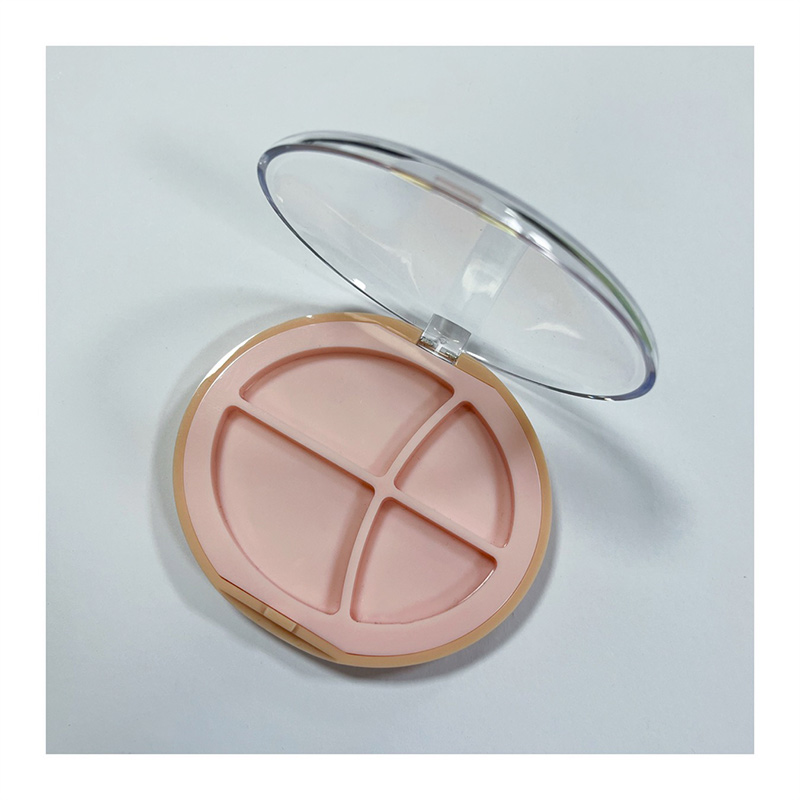
In a clamshell palette or compact, the mirror lives inside the lid — directly behind the hinge line — and its condition over the product's life is governed by the hinge and closure system. Three mechanisms do the damage. First, hinge wear debris: a poorly lubricated or over-tight plastic hinge generates fine polymer and pigment particles as it flexes, and those particles can migrate onto the mirror face where repeated lid closing grinds them into fine scratch networks, visible as a hazy patch near the hinge side of the mirror. Second, lid slam: if the lid free-falls through the last 20–30 mm of travel and hits the base with an audible crack, the impact energy passes through the shell into the mirror bond line and, on glass mirrors, into the glass itself. A single hard slam rarely breaks a healthy 1.5 mm mirror; hundreds of slams over a product's life plus a brittle, over-cured adhesive is a different story. Third, foreign-object entrapment: if the closure design allows shadow powder, glitter, or grit to sit in the base rim, every closing presses that grit against either the pressed pans or the mirror — which is why mirror scratches in returned units so often appear on the half of the mirror nearest the closure rim.
Design-level checks before mass production should therefore cover three numbers. Hinge cycle life: a well-molded integral polypropylene or engineering-plastic hinge in a compact should survive 3,000–5,000 open-close cycles with retention force remaining above the closure-holding requirement; metal-pin hinges in premium palettes should be specified for at least 5,000 cycles with no more than 20% force degradation. Lid closing behavior: specify "controlled closing" — the lid should engage the final detent with resistance rather than free-falling, which on the line is checked by opening the palette fully and timing/witnessing the fall. Clearance: with the lid closed, there should be a designed gap of 0.3–0.8 mm between mirror surface and any opposing feature (pans, rim, decoration) so that nothing can contact the mirror even with a tolerance stack-up and a swollen powder fill. Ask to see the tool's clearance drawing and verify on first-article samples with a feeler gauge at four corners — clearance that exists in the drawing but not in the molded part is a classic tooling shortcut.
Two decoration interactions deserve mention. First, if the lid area around the mirror is painted, plated, or hot-stamped after mirror assembly, masking must be verified: overspray on the mirror face is a 100%-of-lot defect that a careless factory will then "polish out" with abrasives, leaving swirl marks that only show under directional light. Inspect first articles under a single-point light at 45 degrees and look for swirl signatures. Second, printing and hot-stamping on top of the mirror itself (logos etched or printed onto the mirror surface as a decoration trend) multiplies the process risk: the print must be scratch-tested (standard practice is the eraser/rubber abrasion test or alcohol rub, commonly 50 strokes with a cotton pad under ~500 g load) and must not sit within the central "face zone" where users actually look, both for optics and because any print damage there is instantly visible.
The table below consolidates the defects that account for the large majority of mirror-related complaints in eyeshadow palettes and powder compacts, with their root causes at the factory level and the prevention or inspection measure that addresses them. Buyers can use it directly as a starting point for an AQL inspection checklist: the first column maps to what the inspector sees, the second to what to ask the factory, and the third to what to write into the specification.
| Defect / Failure Mode | Typical Root Cause | Prevention / Buyer Check |
|---|---|---|
| Distortion ("funhouse" wavy reflection) | Low-grade thin glass with excessive bow; molded plastic mirror with internal stress; mirror forced into out-of-tolerance recess | Straightedge flatness check (< 0.3–0.5 mm bow over 60 mm); specify substrate and thickness; check recess tolerance on first articles |
| Green or gray tint in reflection | High-iron ("green-edge") glass used instead of clear/low-iron glass; off-color metallizing on plastic | White-paper color neutrality check; specify clear glass (low iron content) for premium palettes |
| Black spots or edge corrosion weeks after delivery | Pinholes or thin coverage in copper/backing paint; unsealed cut edges; moisture ingress at bond line | Backing coverage and edge-wrap inspection; 48 h humidity chamber (40°C/90–95% RH); require edge seal in specification |
| Delamination / hazy or flaking coating | Poor base-coat adhesion on plastic mirrors; contaminated surface before metallizing; under-specified topcoat | Tape adhesion pull test on backing; haze check under point light; require coating system details in writing |
| Scratches out of the box | Mirrors packed loose against each other; hinge wear debris; overspray polished out; no protective PE film | Individual PE film or bagging per mirror; 45-degree point-light swirl inspection; check packing method at inspection |
| Chipped edges and corners | Glass cut without edge-grinding; rough handling; mirrors knocking in the box during transit | Specify edge grinding/deburring; inspect 100% or per AQL under light; compartmentalized inner packing |
| Mirror rattles or falls out | Under-dispensed adhesive; undersized mirror vs recess; partial tape release; insufficient press dwell/cure | Shake test (20–30 cm from ear); twist test; pull-off check on sampled units; define adhesive volume and cure time in process spec |
| Mirror fogging or haze inside closed palette | VOC outgassing from adhesive/inks condensing on mirror; assembly packed before full cure-off | Low-VOC adhesive requirement; 24–72 h post-assembly dwell before packing; 48 h humid-chamber condensation test |
| Mirror cracked after shipping | Brittle thin glass; no protective film/cushioning; carton drop performance below standard | Minimum 1.0–1.5 mm glass for drop-exposed designs; PE film + foam/corrugate packing; ISTA-style drop testing on packed carton |
| Glue overflow at mirror perimeter | Manual dispensing without fixture; wrong bead volume; stacking before adhesive tacks off | Perimeter fingernail check; require robot dispensing or locating fixtures; press/cure dwell in process spec |
Two general patterns are worth internalizing. First, most mirror failures are process failures, not material failures — the factory bought an acceptable mirror and then damaged it through handling, rushed assembly, or skipped cure time. This is good news for buyers, because process failures respond to specification and inspection pressure at low cost. Second, defects cluster at interfaces: mirror-to-adhesive, adhesive-to-shell, mirror-to-hinge, mirror-to-packing. Concentrating your inspection attention on those four interfaces will catch most problems with a fraction of the effort of a general visual check.

None of the checks below requires a laboratory. All of them can be executed in a factory inspection room or even at your office when samples arrive, and together they cover optical quality, coating integrity, mounting security, mechanical durability, and environmental robustness. Sample sizes follow normal AQL practice — for a mid-size production lot, pulling 50–125 units for inspection with tighter subsamples for destructive tests is standard.
Hold the palette under a single bright point light (a phone flashlight is ideal) at roughly 45 degrees and observe the mirror at a matching angle. A high-quality mirror shows a uniform, bright, sharply defined reflection. Distortion shows up as waviness or stretching in the reflected light shape; a green or gray cast appears when compared side-by-side against a known-good reference mirror on white paper; swirl marks from polishing appear as fine circular scratches that catch the light; and coating pinholes appear as tiny dark specks. Move the light slowly across the surface — the sweeping illumination reveals defects that static viewing misses. Allow two to three seconds per mirror; a trained inspector processes 20–30 units per minute at this pace.
Lay a rigid straightedge (a steel ruler with a straightness tolerance, or the edge of a known-flat reference plate) across the mirror face along both diagonals and both center lines. With the mirror edge-lit from behind, gaps between straightedge and glass appear as light lines. Measure any visible gap with feeler gauges. Acceptance guidance: no more than 0.3–0.5 mm of bow over a 60 mm span for glass, with molded plastic mirrors allowed the upper end of that range. For a faster field version, hold the palette and view the reflection of a long straight vertical line (window frame, door edge): straight edges should stay straight and parallel in the reflection. Any visible bowing or pinching of the line indicates distortion above the visible threshold.
Place a sheet of bright white paper on the table. Stand the palette open so the mirror reflects the paper, and place a reference mirror (a verified neutral one you carry to inspections) beside it reflecting the same paper. Look into both mirrors at the same angle. The reflections should be indistinguishable in tint. A greenish cast indicates high-iron glass; a gray or warm cast on plastic indicates an economy metallizing. This check takes ten seconds and has caught more substrate substitutions than any laboratory instrument, because human eyes are extremely sensitive to relative tint differences when two surfaces are adjacent.
On sacrificial samples only, apply a standard pressure-sensitive tape (adhesion in the range of typical packaging tapes) firmly to the mirror's backing paint on the reverse side, then rip it off at a steep angle in one fast motion. Good backing paint stays intact with no paint transfer onto the tape. Pulling away flakes or patches of paint indicates under-cured or poorly bonded backing, which is the precursor to the black-spot corrosion failure mode. On plastic mirrors, the equivalent check on the front face verifies topcoat adhesion of the metallized layer — some transfer of a uniform aluminum dust onto the tape is normal on uncoated metal layers, but patchy flaking that removes the coating down to clear plastic is a fail.
Drop packed and unpacked samples from defined heights onto a hard surface (concrete or tile represents worst-case consumer floors). Practical protocol: three drops per sample — flat on base, flat on lid (mirror side down, the critical orientation), and on the hinge corner — from 0.9 to 1.2 m, which approximates a hand-height drop. Acceptance for a standard palette: no mirror breakage, no mirror detachment, hinge still functional, closure still holding. For glass-mirror palettes this test is precisely why minimum glass thickness and PE film protection belong in the specification; a 0.8 mm unprotected mirror that passes a visual check will fail this test at a rate you will not enjoy discovering through customer returns.
Place fully assembled, closed palettes in a humidity chamber or even a simple insulated box with a tray of warm water maintaining roughly 40°C and 90–95% relative humidity for 48 hours. Remove, allow to cool to room temperature unopened, then open and inspect. Failure indicators: condensation film or droplets on the mirror interior face, adhesive haze rings, black-edge corrosion initiation, blistering of backing paint, or pressed powder surface changes. This single accelerated test simulates weeks of tropical warehouse and bathroom storage and is the most cost-effective environmental screen available. If a factory resists running it, treat that resistance as information.
Cycle the lid through its full open-close travel — by hand at a steady pace of roughly 30–60 cycles per minute, or with a simple cam fixture for larger samples — to the specified count: 3,000 cycles minimum for standard palettes, 5,000 for premium or heavy-lid designs. Evaluate at intervals (500, 1,000, 3,000, 5,000) for hinge whitening and crack initiation at the fold, retention force decay (the lid should still hold closed when the palette is shaken inverted), mirror bond integrity (no rattle at any checkpoint), and scratch accumulation on the mirror from wear debris. A hinge that survives the count but sheds debris onto the mirror fails the test in spirit; note debris accumulation at each checkpoint.

Mirror-related decisions extend beyond the mirror itself into commercial and logistics territory, and several of them deserve attention before mass production rather than after.
Minimum order quantities for mirror components behave differently from shell components. Injection-molded shells are tooling-bound: once the mold exists, small batches are viable with a modest per-unit cost penalty. Mirrors, by contrast, run on shared production equipment (glass silvering lines, vacuum metallizers) and often carry batch minimums from the mirror maker — commonly in the range of several thousand to ten thousand pieces per size and coating specification. When your design uses a non-standard mirror size or shape, confirm whether the factory holds existing tooling for that size or must open a new cutting/molding fixture, because new mirror tooling raises the effective MOQ and adds lead time of one to three weeks. A useful question for your supplier: "What mirror sizes do you already run, and can the palette shell be designed around one of them?" Designing the recess around a stock mirror size is one of the quietest cost reductions available in palette development.
Decoration around the mirror multiplies inspection points. Painted lids must mask the mirror recess; plated shells require the mirror installed after plating (plating baths destroy mirrors, and even the vapor phase of vacuum metallization will coat an unprotected mirror edge); and hot-stamped logos near the recess need positioning tolerance tight enough that the stamping never encroaches on the mirror reveal line. As a rule of thumb, require a 0.5–1.0 mm clearance between any decorated element and the mirror edge, and confirm in first articles that the clearance holds at all four sides, not just the side the photograph shows. When mirror-surface printing is part of the design, treat it as a separate process approval with its own adhesion and scratch testing, and expect a yield loss the factory will want to price in.
Export protection is where mirror-heavy orders most often go wrong, because the packed carton is the last thing anyone inspects and the first thing a freight handler drops. The baseline protection stack is: individual PE film (25–50 micrometers) or a small poly bag on every unit, preventing both scratching and loose-glass dispersion if breakage occurs; molded foam, EPE sheet, or corrugated dividers separating units so they cannot face-contact each other; a master carton with a burst strength appropriate to stack height (for palettes, double-wall corrugated is the common choice for export); and carton fill or inserts preventing internal shifting, because a carton whose contents migrate during transit converts every vibration into mirror-on-shell impact. For drop performance, align expectations with recognized transit-test practice — ISTA-style procedures commonly use sequences of drops from 76 cm to 1 m on cartons up to typical export weights, with repeated drops on corners and edges. You do not need a certified lab to gain most of the value: drop one packed master carton through the sequence yourself at the factory before shipment and open it. Ten minutes of testing routinely prevents five-figure claim letters.
One more commercial point: put the mirror specification — substrate, thickness and tolerance, coating system, edge seal, protective film, and packing method — into the purchase contract or annex, not into an email thread. When a defect dispute arises, the difference between "we discussed it" and "it is in the annex with a rejection clause" is usually the difference between a replacement shipment and an argument.
It depends on positioning and usage. For premium and mid-market palettes where the consumer looks closely at the product, silvered glass is worth its cost: reflectivity of 88–95%, neutral color, flatness under 0.2 mm of bow, and scratch resistance that keeps the mirror looking new for the product's life. For promotional runs, entry-price lines, and formats where drop abuse is likely (travel sizes, teen-focused lines), acrylic at 80–90% reflectivity is a defensible choice that saves cost and weight and eliminates shatter risk. The mistake to avoid is the unrequested substitution — if you specified glass, verify by weight and edge inspection, because acrylic passes a casual glance.
For glass mirrors, 1.0–1.5 mm suits small compacts and mirrors under roughly 50 mm across; 1.5–2.0 mm is the workhorse range for typical palette lids; and 2.0–2.5 mm is reserved for large-format palettes where flatness over a wide span and a substantial feel are priorities. Below 1.0 mm, breakage rates in transit climb noticeably unless packaging is upgraded. For plastic mirrors, 1.0–2.0 mm covers most applications, with the thicker end preferred where bow and flex could distort the reflection. Whatever you choose, hold the tolerance at ±0.1 to ±0.15 mm and match the shell recess accordingly.
Black spotting is corrosion of the silver layer, which means moisture and contaminants reached it. The usual causes are pinholes or under-thickness in the copper and backing paint, unsealed cut edges where the silver stack is exposed, or moisture wicking along the mirror-to-shell bond line. It accelerates sharply above roughly 80% relative humidity. Prevention is on the supplier side (full-coverage backing, edge sealing, adequate paint cure) and on the logistics side (avoid shipping containers that cook and humidify — a container at 50°C with moisture-rich cargo condenses water inside the packaging). The 48-hour humidity chamber test before shipment screens for exactly this failure.
Use the reflection of a straight reference line. Hold the open palette and look at a door frame, window edge, or the seam between wall and ceiling. In a flat mirror the line stays straight and its two mirror images remain parallel and continuous. Distortion shows as bowing, waviness, or a line that breaks or shifts where it crosses zones of the mirror. Combine this with the straightedge-and-feeler-gauge check on the mirror surface itself (accept up to 0.3–0.5 mm of bow over 60 mm) and you have a distortion screen as effective as most instrumented methods for this product category.
Industry practice for integral plastic hinges in compacts and palettes is a minimum of 3,000 open-close cycles, with 5,000 cycles specified for premium products and heavy lids. Testing can be as simple as manual cycling at a steady pace with documented checkpoints at 500, 1,000, 3,000, and 5,000 cycles, evaluating hinge whitening, crack initiation, closure retention (shake the inverted palette — the lid must stay shut), mirror rattle, and wear debris on the mirror. A palette opened twice a day will see about 2,000 cycles over three years, so the 3,000–5,000 range builds in margin for consumers who open and close frequently while shopping or demonstrating the product.
Yes to the film through manufacturing and transit: a 25–50 micrometer PE protective film on the mirror face prevents scratches during assembly, packing, and shipping, and doubles as containment if glass breaks. Whether it stays on for retail is a product decision — many palettes ship to consumers with a pre-applied film and a "peel before use" note, which guarantees the customer's first view of the mirror is scratch-free. If you remove the film at your facility, do so in a clean area and re-bag promptly, because exposed mirrors contacting foam, fabric, or each other will pick up fine scratches even in a clean-looking workspace.
Mirror quality is one of the highest-visibility, lowest-cost aspects of eyeshadow palette packaging, which makes it one of the best places to focus pre-production attention. The specification decisions are straightforward: choose the substrate deliberately — silvered float glass at 1.0–2.5 mm for premium clarity, PMMA or PC where weight, cost, or impact resistance dominate — and write substrate, thickness tolerance, coating system, and edge seal into the contract. The process risks are concentrated at four interfaces: the adhesive bond line (watch glue overflow, tilt, and rattle), the hinge and closure (control slam behavior and confirm 3,000–5,000 cycle life), the decoration boundary (masking and clearance of 0.5–1.0 mm), and the export packing (PE film, unit separation, and carton drop performance). And the verification is entirely practical: a flashlight at 45 degrees, a straightedge with feeler gauges, white paper, a roll of tape, a drop from one meter, a humid box for two days, and a patient hand cycling a hinge. A buyer who runs those seven checks on golden samples and on the first production cartons will intercept the mirror defects that otherwise surface as customer reviews — distortion, tint, corrosion, scratches, and mirrors loose in the bag — at a cost of hours rather than the cost of a failed launch. Before your next mass production run, put the mirror on the checklist explicitly; it is the component your end customer looks into, and the one she will judge your brand by.
Jinhua Xingqiao Plastic Industry Co., Ltd.
 Mobile phone: +86-13868982062
 Telephone: +86-579-82196667
 Fax: +86-579-82196656
 E-mail: sales@zjxqpackaging.com
 Address: 377 Yongxue Street, Wucheng District, Jinhua City, Zhejiang Province, China
Copyright © 2022 Jinhua Xingqiao Plastic Industry Co., Ltd
This website uses cookies to ensure you get the best experience on our website.



 Phone
Comment
(0)